Defensible Innovation Grounded in Computational Social Science
Artificial Intelligence promises transformative value for enterprises, but achieving success requires more than technology alone.

The failure rate
70–85%
of AI projects miss their expected outcomes
An estimated 70-85% of AI projects fail to meet their expected outcomes due to a rush to implement without fully appreciating internal and external limiters. Our pre-transformation analysis utilizes rigorous computational social science methodologies to systematically diagnose these constraints before deployment resources are allocated.
The paradigm
Many corporate AI initiatives struggle due to a premature implementation focus that overlooks organizational readiness. As a human-AI native strategy partner, empakt applies The Sensemakers AI Strategy Framework to guide enterprise deployment. This quantitative approach balances qualitative insights with data-driven scoring to ensure that AI projects are treated as managed strategic initiatives rather than risky, speculative ventures.
The evaluation framework assesses three core concepts to prioritize areas where AI is most likely to succeed and add value.
The AI Scorecard Matrix
Scroll to score
Evaluates an organization's environmental context against potential use cases to determine if a given business problem is suited for AI. By analyzing task complexity and data availability, executives gain a multi-parametric score to prioritize cases with the highest chance of success.
Execution methodology
From initial analysis to execution, the framework offers an optional roadmap to accelerate learning and disciplined enterprise-wide adoption.
Step 01
D
Identify and scope AI opportunities aligned with strategic goals.
Step 02
I
Deep-dive analysis of data, readiness, and feasibility factors.
Step 03
V
Rapid experimentation and hypothesis testing to prove value.
Step 04
E
Disciplined implementation tracked against measurable outcomes.
Under the hood
The AI Strategy Framework combines qualitative insights with quantitative data-driven scoring to guide decision-making.
Uses logarithmic scales for certain metrics to normalise wide-ranging data (such as very large data volumes or user counts) so that one factor doesn't skew the overall results.
Incorporates probabilistic models to account for uncertainty in projections. Rather than relying on single-point estimates, it evaluates scenarios across best-case, expected, and worst-case outcomes.
What you get
01
Ensures AI initiatives align directly with business strategy, so each project targets high-impact areas and solves meaningful problems.
02
Enables better prioritization by focusing capital and engineering resources on initiatives that are technically feasible and likely to generate strong returns.
03
Flags capability gaps, data weaknesses, and potential pitfalls early, helping to avoid underprepared projects and unrealistic expectations, thereby reducing the risk of failure.

Decision Making Clarity
AI Practice Powered by The Sensemakers
A concise yet comprehensive toolkit that turns AI from a risky venture into a managed strategic initiative.

Roop Bhadury
The Sensemakers
The platform

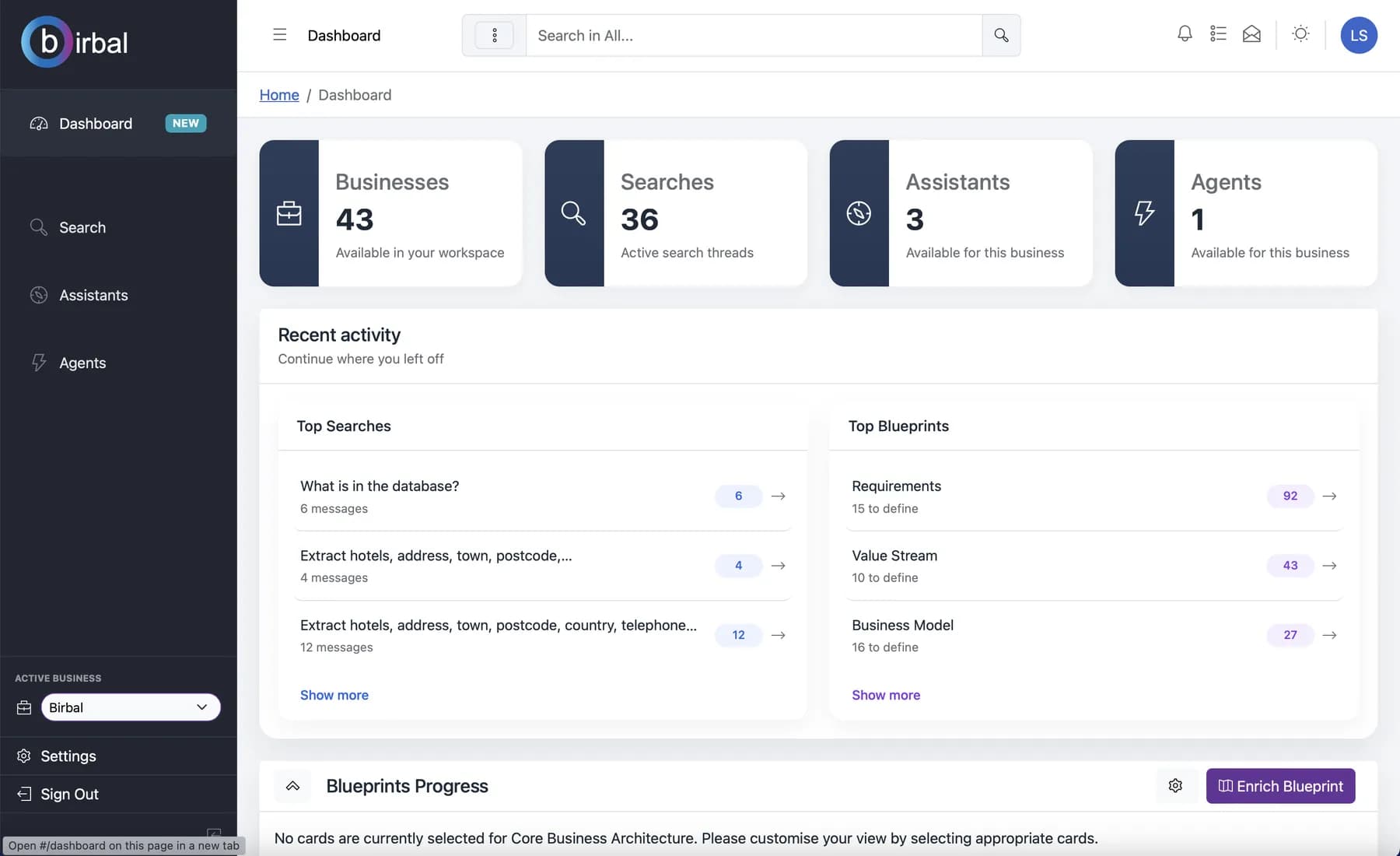
Birbal is Ai enabled tool which turns fragmented enterprise knowledge into connected, reusable intelligence - helping teams discover evidence, understand dependencies and make better decisions across the business and software development lifecycle.
From fragmented knowledge to reusable intelligence
Step 01
Business capabilities, architecture, processes and operational evidence.
Enterprise knowledge
Step 02
Relationships, dependencies, gaps and impacts.
Enterprise reasoning
Step 03
Generate governed requirements, designs, processes and decisions.
Enterprise outcomes
Birbal enables discovery, quicker decisions and better-quality artefacts required to deliver projects, efficiently.

Decisions remain grounded in enterprise source material.
Knowledge and decisions persist across teams, projects and lifecycle stages.
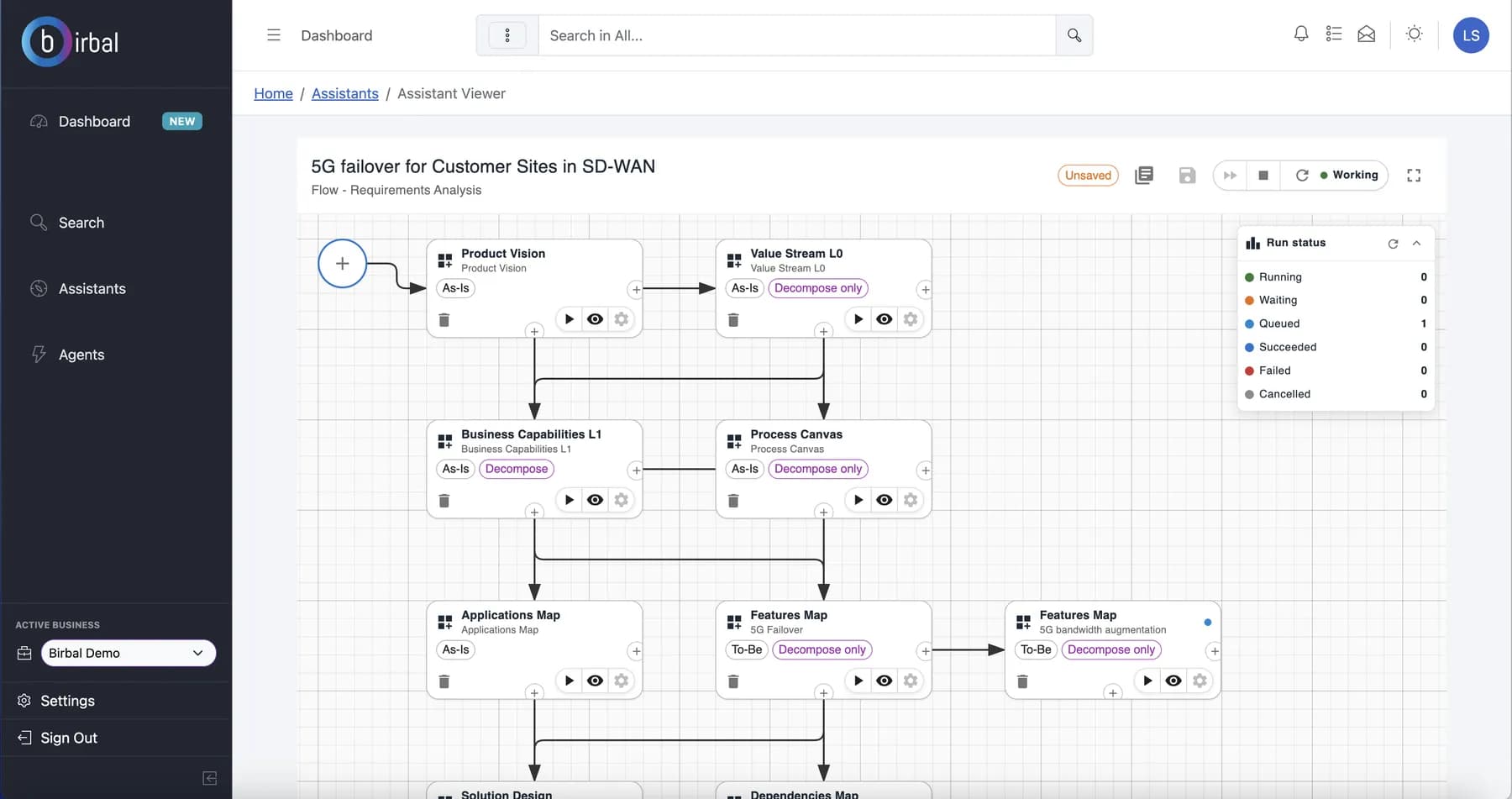
Birbal connects business capabilities, processes, systems and architecture to expose downstream impact.
Validated knowledge is structured once and reused instead of repeatedly reconstructed.
Context engineering
Birbal manages context before the LLM call - retrieving, structuring and compressing only what is relevant.

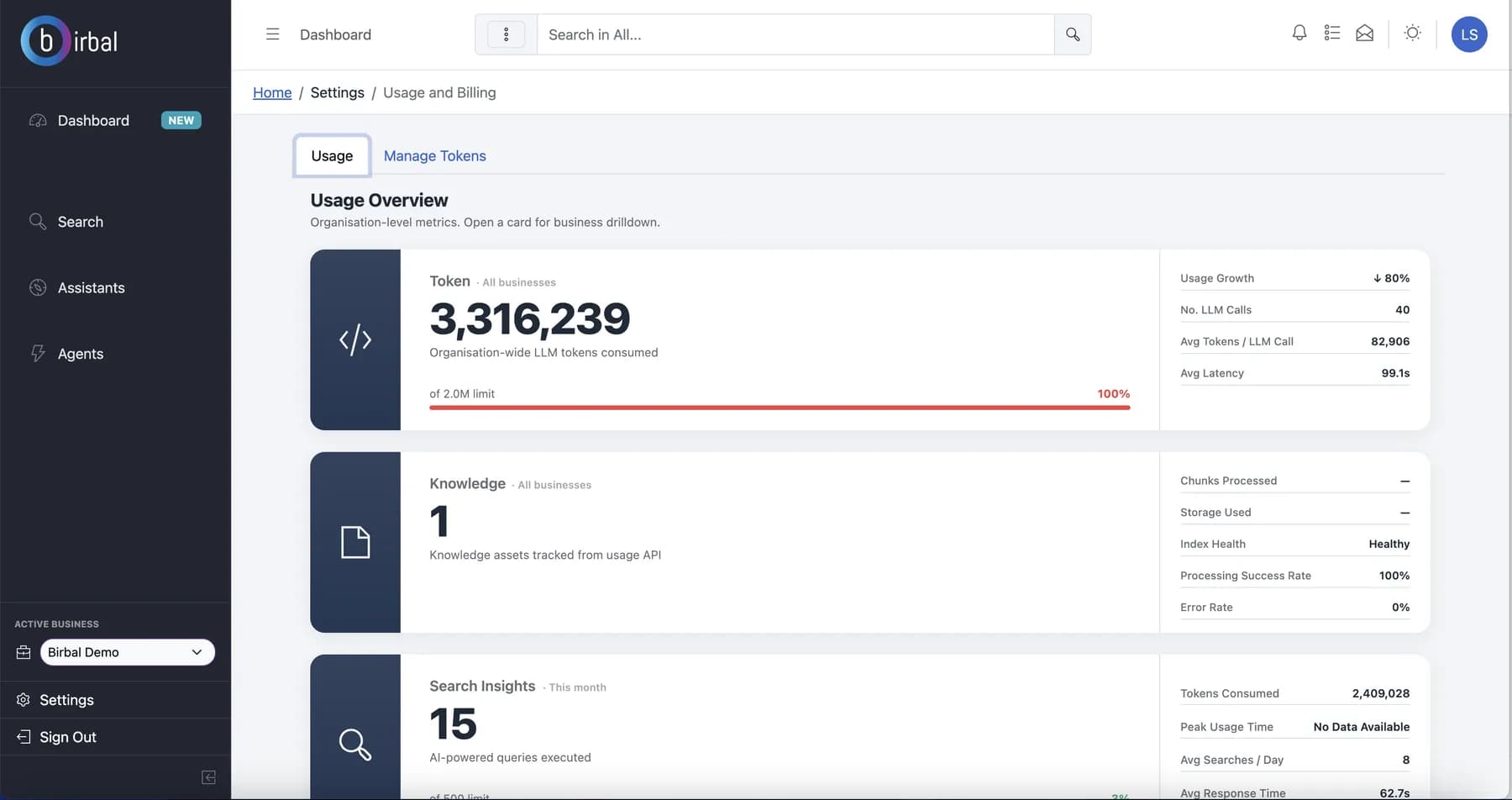
Birbal tracks token usage so you stay in control and get maximum value from AI.

Most AI assistants optimise individual tasks. Birbal optimises enterprise decisions, with outputs governed.
It connects knowledge across teams and projects, preserves enterprise context, surfaces hidden dependencies and governs how outputs are created and reused.
The Birbal advantage
From faster individual work to better enterprise outcomes.
Birbal benefits
Speed
~35%
faster discovery
Quality
~30%
less rework
Predictability
~20%
fewer milestone delays
Discover once. Connect once. Reuse continuously.
Birbal AI works alongside the human, and the human takes control as needed. Teams remain engaged and own the output - which is what makes AI adoption, and its benefits, actually stick.
Birbal transforms enterprise knowledge from passive documentation into an active decision-making asset.

Lokendra
Birbal AI